The Editing Shift: Abode Premier Pro in Free
For years, the professional video editing(Abode Premier Pro in Free) world was defined by a single, expensive tether: the high-end desktop workstation. If you wanted to cut 4K footage or apply studio-grade color grading, you were locked into a $3,000 rig and a stationary desk. But the landscape is shifting. Today’s creators are increasingly trading heavy hardware for “anywhere, anytime” production.
The expectation for high-octane production quality hasn’t dropped just because the hardware has shrunk; if anything, the “creator-on-the-go” now faces more pressure than ever to deliver studio results from a coffee shop or a plane. This transition isn’t just about convenience—it’s a strategic survival necessity. From professional-grade apps fitting into your pocket to cloud-powered terminals, the barriers to entry are dissolving, provided you know how to navigate the new rules of the game.
SCROLL DOWN TO DOWNLOAD
1. The King is Dead—Premiere Rush Makes Way for Mobile Pro Power
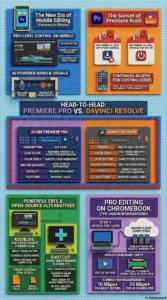
The era of “lightweight” mobile editing is officially over. Adobe recently announced the “End of Life” for Premiere Rush, which will be removed from app stores on September 30, 2025, and officially discontinued on September 30, 2026. Taking its place is the new Premiere on iPhone, a move that represents a massive branding win for Adobe. By sunsetting the “Rush” name, Adobe is ditching the lightweight, hobbyist stigma and aligning its mobile experience with the “Pro” reputation of its flagship desktop suite.
The new iPhone app is more than a name change; it’s a shift toward professional-grade creative control on mobile. While the app itself is free, Adobe has integrated a modern monetization strategy: users can pay for upgrades to secure additional storage and generative AI credits.
“We’re excited to bring the power of Premiere to creators’ fingertips, delivering pro-level creative control, without the pro-level complexity,” said Mike Polner, vice president, product marketing, creators at Adobe. “Premiere on iPhone makes it easy for creators to craft and share stories on mobile with studio-quality audio, precise editing tools and stunning visuals.”
This strategy signals that mobile editors no longer want a “diet” version of the software. They want the real deal—multi-track timelines and AI-enhanced audio—right in their pockets.
2. Your Chromebook is Finally a Video Editing Powerhouse (With a Catch)
Chromebooks were never meant to be workstations. Designed for web-based tasks and light productivity, they lack the local CPU and GPU “juice” required to handle a modern non-linear editor (NLE). However, the rise of the “Cloud VM” has turned the Chromebook into a powerful terminal rather than a weak workstation.
By offloading the heavy lifting to remote servers, you can now run full desktop versions of Premiere Pro on a device that costs less than a lens. This is achieved through three primary strategic workarounds:
- Vagon Cloud Computer: This is the heavyweight champion of the cloud approach. It runs Premiere Pro on remote servers equipped with high-end GPUs like the NVIDIA Tesla or A10G. It supports RTX features and allows users to scale their specifications—meaning you can boost your VM’s RAM and GPU power depending on whether you’re cutting a simple 1080p social clip or rendering a complex 4K short film.
- Remote Desktop Access: Tools like Chrome Remote Desktop stream the power of a home-based PC to your Chromebook.
- Linux (Crostini) and Wine: A technical local workaround using a compatibility layer to run Windows applications in a Linux environment.
For the traveling creator, this “cloud-first” architecture is a game-changer, provided you have the stable internet bandwidth to maintain the connection.
3. The “14-Day Rule” and the 5GB Storage Trap
In the subscription age, software “ownership” is an illusion that requires careful management of the fine print. Adobe’s ecosystem contains several discrepancies that can catch a creator off guard during a transition or cancellation.
First, there is the 14-Day Rule: users have exactly 14 days from the initial purchase to cancel for a full refund. Beyond that, you are often locked into the financial commitment of your plan. The real danger, however, lies in your assets. When you cancel, your allowed cloud storage is slashed to a mere 5GB. Any remaining Generative Credits you’ve accumulated also expire immediately upon cancellation.
Pro-Tip: If you exceed the 5GB limit post-cancellation, you have exactly 30 days to move or download your files before you risk losing them forever.
Interestingly, there is a confusing discrepancy in how Adobe treats different media: while general Creative Cloud files have that 30-day window, Adobe will store Lightroom images for one year after a membership lapses. This lack of uniformity makes local backups an absolute requirement for any professional workflow.
4. The “Colorist Advantage”—Why DaVinci Resolve is Winning the Value War
While Adobe Premiere Pro remains a titan of the industry, Blackmagic Design’s DaVinci Resolve is winning the value war through a radically different pricing philosophy and technical architecture. Premiere Pro costs 22.99/month (263/year), whereas DaVinci Resolve Studio offers a $295 lifetime license that includes all future updates.
The Strategic Price Breakdown:
- Subscription Model (Premiere Pro): Ongoing costs that never end.
- Lifetime License (DaVinci Resolve): A one-time fee, often included for free with the purchase of Blackmagic cameras.
“After just one year with Premiere Pro, you would have paid twice the price of DaVinci Resolve [Studio].”
The difference goes deeper than the wallet; it’s about the underlying architecture. Professionals often prefer Resolve’s node-based system, which provides significantly more granular control for color grading and VFX. In contrast, Premiere’s Lumetri tools use a layer-based system that resembles the workflow in Photoshop or Lightroom. While layers are easier for beginners to grasp, nodes allow for complex, non-destructive branching that is the industry standard for high-end colorists. Furthermore, Resolve offers native support for Blackmagic RAW, a crucial technical edge that Premiere lacks.
5. Open Source is No Longer “Just for Amateurs”
Free and Open Source Software (FOSS) has matured into a legitimate professional alternative for creators looking to escape the “Adobe Tax.” These aren’t just toys; they are technical powerhouses built on robust frameworks.
- Kdenlive: This editor is a favorite for those needing high performance on modest hardware. It supports proxy editing, creating low-res versions of massive clips for smooth playback, and offers advanced keyframing for animations, giving it a professional edge in motion graphics.
- Shotcut: This is a “codec independent” powerhouse. Because it uses the FFmpeg framework, it can encode or transcode to almost any format without relying on system codecs. It supports 4K and 8K resolutions natively and doesn’t require a traditional “import” process, allowing for direct timeline editing.
These tools prove that the technical depth required for multi-track editing and high-resolution output is no longer locked behind a subscription paywall.
Conclusion: The Tool Doesn’t Make the Story, But the Right One Helps
The modern editing landscape is more fragmented—and more powerful—than ever before. Whether you are using the new Premiere app on an iPhone to cut a viral vlog or utilizing a cloud-based VM to tap into an NVIDIA A10G from a Chromebook, the “best” software is the one that aligns with your specific workflow and financial strategy.
As pro-level creative control shifts from the stationary desk to the pocket and the cloud, we have to ask: In a world where 4K editing power is now ubiquitous and decoupled from local hardware, is the massive desktop workstation still the industry standard, or is it becoming the “mainframe of the 2020s”—a powerful but increasingly auxiliary legacy habit?
DOWNLOAD NOW For Windows
DOWNLOAD FOR MAC
Adobe Video Ecosystem and Market Comparison: Adobe Premiere Pro in Free
Executive Summary
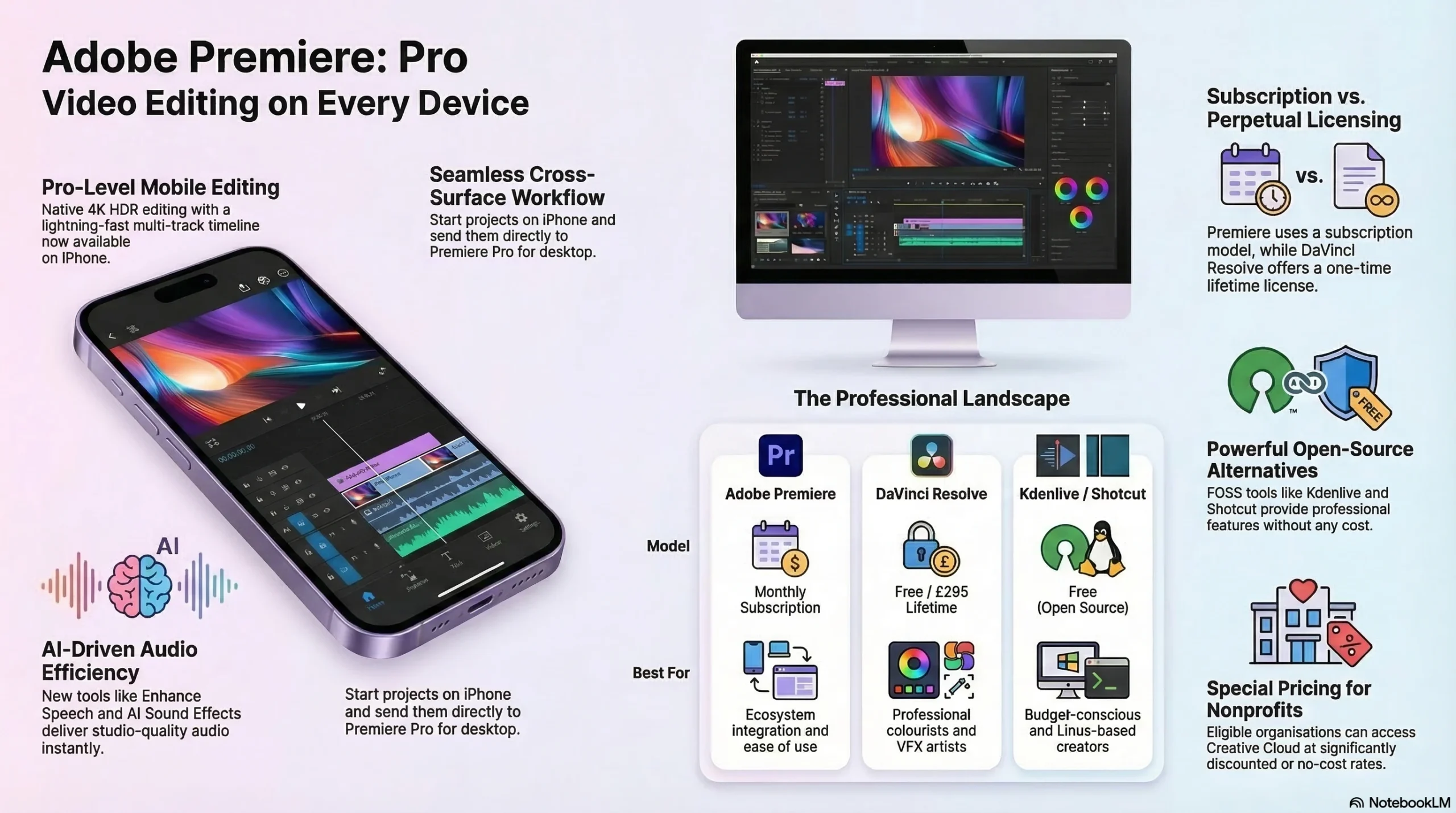
The digital video editing landscape is currently defined by Adobe’s strategic pivot toward mobile professionalization and AI integration, alongside intensifying competition from lifetime-license and open-source alternatives. In September 2025, Adobe launched a powerful, free-to-start Premiere app for iPhone, while simultaneously announcing the retirement of Premiere Rush. This transition aims to consolidate users into a unified ecosystem where mobile projects can seamlessly transition to Premiere Pro on desktop.
While Adobe maintains dominance through its Creative Cloud integration and beginner-friendly interfaces, competitors like Blackmagic Design’s DaVinci Resolve offer superior value propositions through lifetime licenses and industry-standard color grading. Additionally, open-source tools like Kdenlive and Shotcut are emerging as viable, no-cost alternatives for creators seeking to escape the “subscription trap.”
——————————————————————————–
Adobe Product Evolution and Strategy
The Launch of Adobe Premiere Pro in Free on iPhone
As of September 30, 2025, Adobe has officially brought the Premiere brand to mobile with a dedicated iPhone app designed to deliver professional-grade creative control without “pro-level complexity.”
- Core Capabilities: The app features a multi-track timeline, 4K HDR editing, and frame-accurate trimming.
- AI Integration: Includes “Enhance Speech” for audio clarity and “Generative Sound Effects.”
- Ecosystem Connectivity: Projects started on the mobile app can be sent directly to Premiere Pro on desktop for further refinement.
- Monetization: The app is free for basic use; users can upgrade for additional storage and generative AI credits.
The Retirement of Premiere Rush
To streamline its product line, Adobe has scheduled the “End of Life” (EOL) for Premiere Rush.
- Timeline:
- September 30, 2025: Premiere Rush will be removed from all app stores and Adobe.com. Subscription renewals will cease.
- September 30, 2026: Technical support ends, and the app may cease to function entirely.
- Replacement Strategy: Adobe identifies Premiere on iPhone and Premiere Pro on desktop as the official successors for Rush users.
——————————————————————————–
Competitive Market Analysis: Premiere Pro vs. Alternatives
Professional Tier: DaVinci Resolve
Blackmagic Design’s DaVinci Resolve remains the primary commercial rival to Adobe Premiere Pro.
| Feature | Adobe Premiere Pro | DaVinci Resolve |
| Pricing Model | $22.99/mo (Subscription Only) | $295 (Lifetime) + Powerful Free Version |
| Learning Curve | Beginner-friendly; welcoming UI | Steeper; daunting for novices |
| System Logic | Layer-based system | Node-based system |
| Core Strength | Integration with Creative Cloud (After Effects, etc.) | Industry-standard color grading and Fairlight audio |
| Stability | Known for frequent crashes on some hardware | Generally more stable; faster rendering |
Open-Source Alternatives (FOSS)
For users prioritizing cost and independence from subscriptions, several open-source tools provide high-level functionality.
- Kdenlive: A non-linear editor that supports advanced keyframing, multi-track editing, and proxy editing (working with low-res versions of large files). It is cross-platform (Linux, Windows, BSD) and handles audio with detailed visual waveforms.
- Shotcut: Noted for its wide format support (via FFmpeg) and independence from system codecs. It supports 4K/8K resolutions, 10-bit video end-to-end, and can run as a portable app from an external drive.
- OpenShot: Favored by some users for its Blender dependency, which assists in graphics support.
——————————————————————————–
Commercial and Accessibility Frameworks
Subscription and Trial Management
Adobe’s commercial model is strictly subscription-based, managed through the Adobe ID system.
- The 7-Day Trial: Users can access the full version of Premiere Pro for seven days. On Day 8, billing begins automatically.
- Refund Policy: A full refund is available if a subscription is canceled within 14 days of the initial purchase.
- Post-Cancellation Access:
- Cloud storage is reduced to 5GB.
- Users have 30 days to migrate files before potential loss of access.
- Lightroom original images are stored for one year post-lapse, though the Develop/Map modules become inaccessible.
Nonprofit and Organizational Access
Adobe provides discounted pricing for qualified organizations, though eligibility is strictly defined.
- Eligibility: Qualified 501(c)(3) public charities (or international equivalents) with missions such as poverty relief, education advancement, or human rights.
- Ineligible Entities: Private foundations, hospitals, government agencies, and political/lobbyist organizations are generally excluded from nonprofit pricing.
- Nondiscrimination: Organizations must adhere to strict nondiscrimination policies in hiring and service provision to qualify.
——————————————————————————–
Platform and Hardware Implementation
The Chromebook Challenge
Chromebooks are inherently ill-equipped for native Premiere Pro operation due to Chrome OS constraints and modest hardware. However, several “workarounds” exist for mobile professionals:
- Vagon Cloud Computer: The most reliable method, utilizing a high-performance Virtual Machine (VM) in the cloud to handle processing while the Chromebook acts as a display.
- Remote Desktop: Accessing a powerful Windows/Mac workstation via Chrome Remote Desktop or TeamViewer.
- Linux (Crostini) and Wine: A technical workaround that attempts to run the Windows version of Premiere locally, though it is prone to instability and performance lag.
Hardware Optimization Tips
- Internet Speed: Cloud-based editing requires a minimum of 10 Mbps for basic tasks and 50+ Mbps for 4K footage.
- Thermal Management: Extended editing sessions on lightweight laptops like Chromebooks often lead to overheating and performance throttling.
- Storage: Users are encouraged to use external SSDs for raw footage to bypass the limited local storage of mobile devices and Chromebooks.
——————————————————————————–
Key Technological Innovations: AI and Generative Credits
Adobe has embedded AI into the core editing workflow to automate labor-intensive tasks:
- Generative Extend: Uses Firefly AI to add frames to clips or lengthen ambient audio.
- Text-Based Editing: Automatically generates transcripts, allowing users to edit video by simply cutting and reordering text.
- Object Mask (Beta): Replaces manual rotoscoping by using AI to track and mask subjects with a single click.
- Generative Credits: Adobe plans now include a monthly allotment of “generative credits” (e.g., 25 per month for individual Premiere plans) to power these AI features. These credits do not roll over and expire upon subscription cancellation.
Important Quotes
“We’re excited to bring the power of Premiere to creators’ fingertips, delivering pro-level creative control, without the pro-level complexity.” — Mike Polner, VP of Product Marketing, Adobe
“After one year with Premiere Pro, you would have paid twice the price of DaVinci Resolve.” — Market Comparison Analysis
“Free and open-source software (FOSS) has had a reputation for being inferior… but Kdenlive will save you considerably if you primarily use Adobe Creative Cloud for Premiere Pro.” — XDA Developers Analysis
Video Editing and Software Management Study Guide
This study guide provides a comprehensive overview of the current video editing landscape, focusing on the launch of Adobe Premiere for mobile, subscription management, nonprofit eligibility, and a comparative analysis of leading professional and open-source editing platforms.
——————————————————————————–
Part I: Knowledge Review Quiz
Instructions: Provide short-answer responses (2-3 sentences) for each of the following questions based on the provided source context.
- What are the primary features of the new Adobe Premiere mobile app for iPhone launched in September 2025?
- What criteria must a nonprofit organization meet to be eligible for Adobe’s discounted pricing programs?
- Explain Adobe’s refund policy for new subscriptions and the 7-day free trial.
- How do the user interface philosophies of Adobe Premiere Pro and DaVinci Resolve differ?
- Compare the pricing models of DaVinci Resolve Studio and Adobe Premiere Pro over a one-year period.
- What is the timeline and replacement plan for the “End of Life” of Adobe Premiere Rush?
- What specific technical advantages does Shotcut offer regarding platform compatibility and file management?
- How does the Vagon Cloud Computer workaround enable video editing on a Chromebook?
- What are “proxy editing” and “keyframing” in the context of the Kdenlive open-source editor?
- What happens to a user’s cloud storage and files if they cancel their Adobe Creative Cloud subscription?
——————————————————————————–
Part II: Answer Key
- Adobe Premiere Mobile Features: The app features a lightning-fast multi-track timeline, studio-quality audio with AI-powered “Enhance Speech,” and perfectly timed sound effects. It also includes 4K HDR editing, instant background removal, and commercial-safe generative AI tools for assets like stickers and background expansion.
- Nonprofit Eligibility: Organizations must be qualified 501(c)(3) public charities in the U.S. or the local equivalent abroad, operating on a not-for-profit basis to benefit the community. They must provide official tax-exempt identification and adhere to a strict nondiscrimination policy regarding hiring and service access.
- Refund and Trial Policy: Adobe offers a 7-day free trial that converts to a paid membership on the eighth day if not canceled. For most plans, users can receive a full refund if they cancel within 14 days of the initial purchase.
- UI Philosophies: Premiere Pro utilizes a beginner-friendly, layer-based system with customizable panels that integrate with other Creative Cloud apps. In contrast, DaVinci Resolve employs a more complex node-based system and a “Pages” workflow that separates post-production stages like cutting, color, and audio (Fairlight).
- Pricing Comparison: DaVinci Resolve Studio costs a one-time fee of $295 for a lifetime license, whereas Premiere Pro costs $22.99 per month or $263.88 annually. After just one year, a Premiere Pro user will have spent nearly double the cost of a lifetime DaVinci Resolve Studio license.
- Premiere Rush Transition: Premiere Rush will be removed from app stores on September 30, 2025, with all technical support ending on September 30, 2026. It is being replaced by the new Premiere on iPhone app and Premiere Pro on desktop.
- Shotcut Advantages: Shotcut is a cross-platform, open-source editor that is “codec independent,” meaning it does not rely on system codecs to function. It supports resolutions up to 8K, can run as a portable app from an external drive, and utilizes FFmpeg for wide format support.
- Vagon Cloud Workaround: Vagon allows users to run Premiere Pro on a high-performance virtual machine (VM) hosted in the cloud, bypassing the Chromebook’s modest local hardware. The VM utilizes powerful remote GPUs and CPUs to handle processing, while the Chromebook merely displays the output via a browser.
- Kdenlive Features: Proxy editing allows Kdenlive to create low-resolution versions of large clips for smoother playback during the editing process. Keyframing is used for both animations and audio, allowing users to define specific points in time where properties like volume or position change.
- Post-Cancellation Storage: Upon cancellation, cloud storage is reduced to 5 GB, and users have 30 days to move files before potentially losing access. Adobe stores Lightroom images for one year post-lapse, while files saved locally on the user’s computer remain accessible.
——————————————————————————–
Part III: Essay Questions
Instructions: Use the provided source materials to develop comprehensive responses to the following prompts. (Answers not provided).
- The Evolution of Mobile Editing: Discuss how the features and AI integration in the new Adobe Premiere iPhone app represent a shift from “lightweight” mobile editing (like Premiere Rush) to “pro-quality” mobile production.
- Subscription vs. Perpetual Licensing: Analyze the long-term financial and functional implications for a freelance editor choosing between the Adobe Creative Cloud subscription model and the DaVinci Resolve lifetime license model.
- The Viability of Open Source: Evaluate the strengths and weaknesses of open-source tools like Kdenlive and Shotcut when compared to industry-standard commercial software. Can these tools realistically satisfy the needs of professional environments?
- Cloud Computing and Hardware Limitations: Examine the role of cloud-based solutions (like Vagon) and remote desktop access in democratizing high-end video production for users with low-spec hardware such as Chromebooks.
- Organizational Barriers to Access: Review Adobe’s nonprofit eligibility requirements. Discuss the impact of excluding certain entities—such as hospitals and government-funded labs—from discounted pricing, and the importance of the nondiscrimination policy in these programs.
——————————————————————————–
Part IV: Glossary of Key Terms
| Term | Definition |
| 501(c)(3) | A specific tax-exempt status in the United States for public charities and nonprofit organizations. |
| Codec Independent | Software that does not rely on the host operating system’s installed codecs, often utilizing internal libraries like FFmpeg. |
| Color Grading | The professional process of altering and enhancing the color of a motion picture or video for aesthetic and narrative purposes. |
| Crostini | The technology that allows Chrome OS to run a Linux-based virtual machine, enabling the installation of Linux desktop apps on Chromebooks. |
| Enhance Speech | An AI-driven tool in Adobe Premiere designed to remove background noise and make voice recordings sound like they were recorded in a professional studio. |
| Fairlight | A dedicated audio post-production tab within DaVinci Resolve that functions as a full digital audio workstation (DAW). |
| FFmpeg | A leading multimedia framework used by software like Shotcut and Kdenlive to support a vast range of audio and video formats. |
| Fusion | The visual effects (VFX) and motion graphics workspace within DaVinci Resolve that utilizes a node-based workflow. |
| Generative Credits | A form of currency within the Adobe ecosystem used to power AI-driven tasks like “Generative Extend” or image generation. |
| Layer-based System | A UI approach (used in Premiere Pro) where media and effects are stacked vertically on top of one another. |
| Lumetri Color | The dedicated color correction and grading toolset found within Adobe Premiere Pro. |
| Node-based System | A UI approach (used in DaVinci Resolve) where effects and adjustments are connected via “nodes” in a flowchart-like structure for granular control. |
| NLE (Non-Linear Editor) | Video editing software that allows the editor to access any frame in a digital video clip regardless of the sequence. |
| Proxy Editing | An editing workflow where low-resolution copies of high-resolution footage are used to improve system performance during the edit. |
| VIP Marketplace | Adobe’s program for organizations to purchase and manage business and nonprofit licenses through resellers. |
| Wine | A compatibility layer used to run Windows applications on Linux-based operating systems. |
——————————————————————————–